

Better to Light One Candle, Than to Curse the Darkness…
45 Years Later and the Legacy of the 1981 Mine Disaster at Coal Basin Still Lingers
By The Crystal Valley Echo Staff
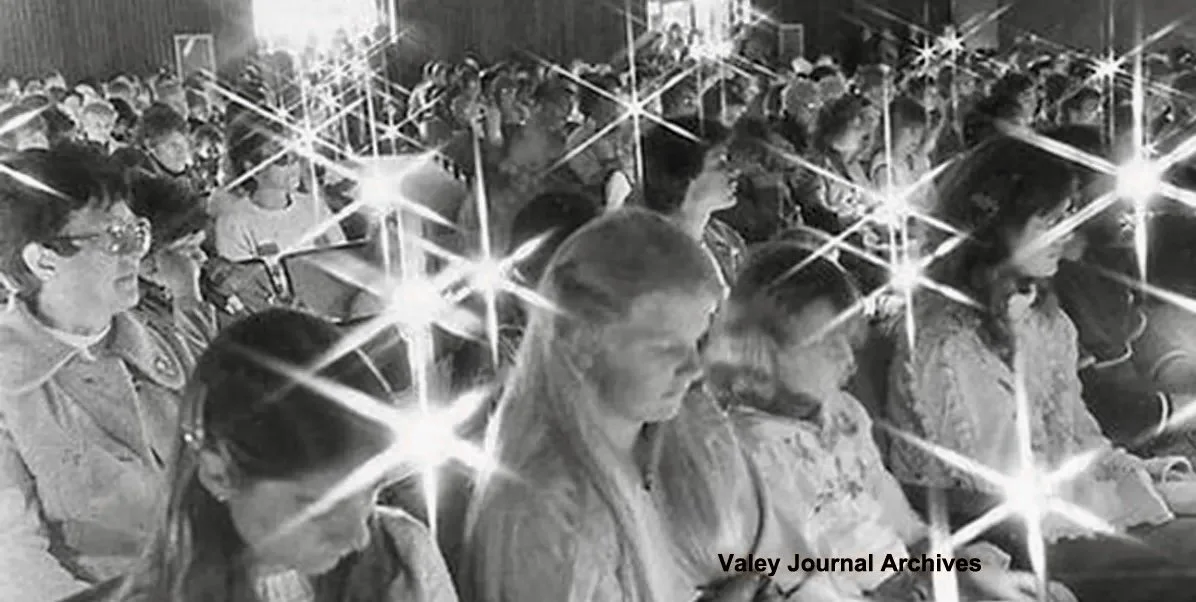
Valley Journal File Photo by Patti Barry Levy of the candlelight vigil for the 15 lost miners held at Roaring Fork High School after the tragedy. Over 500 people were in attendance.
REDSTONE- Situated high above the village of Redstone, on a sheer rock outcropping over 10,000 feet from sea level lies the access portals for the Dutch Creek Mine at Coal Basin. Often discussed as a remnant of John C. Osgood’s Colorado Fuel & Iron Company, and a hallmark of the turn-of-the-century founding and boom town days of Redstone. For Roaring Fork and Crystal Valley locals, the days of Mid-Continent Resources’ management of the mines are far clearer in focus. The thrum of mountain life, and the mountains themselves have been some of the most attractive aspects of our valleys since the earliest days of human inhabitation in the American West for their natural beauty, and the myriad activities that they hold for all of us in all seasons. What has faded from tourism brochures and the daily lives of our residents as the years have passed and times have changed is the fact that for so much of the shared history in this valley, life was as much about time spent under the mountains, as it was about time spent on their slopes.
April 15th, 1981 began as a calm, clear spring day in Redstone, just as it did in Marble, Carbondale, Aspen, Basalt, Glenwood Springs, Somerset, or Paonia. Birds were no doubt singing, the gentle rhythm of the flow of the Crystal River churned its way from the high-altitude headwaters all the way to the confluence at the North end of Carbondale. In the warm spring sun, our communities slowly began to awaken and go about their days. Kids of all ages prepared for another typical Wednesday at school as the fun of summer vacation approached with each passing week. Snow still dotted the peaks of Sopris, Maroon Bells, The Elk Mountains and the faraway peaks surrounding the valley. Mail was delivered, cows, kids, horses, husbands, sheep, dogs and cats were fed, groceries were purchased. It was the idyllic picture-perfect day in the life that so many of us love to experience here.
Like all dark days, it began peacefully.
By late afternoon disaster struck, deep in the Dutch Creek No. 1 Mine the ground shook, the air rushed and an explosion was heard and felt 18 miles below on Redstone Boulevard.
What would follow would be some of the darkest days our communities have ever experienced together. However, those days between the initial moments of the disaster and the rescue and recovery efforts undertaken would come to define the threads of community that hold us all together even today, a line between teachers, parents, brothers and sisters, grandparents, friends, colleagues, and strangers, in our darkest moment held a community together through hope, grief, and care that transcended the differences that would otherwise have kept us apart.
The day at Coal Basin began as any other would have, with the incoming shift preparing to delve into the dark of Dutch Creek No. 1 for another day of extracting coal for Mid-Continent. Dutch Creek No. 1 was one of five mines in the Coal Basin mining complex that mined coal from the Coal Basin “B” coalbed. It had six entries driven from the surface, numbered 1-4 and 6 and 7, with entry number five beginning 1300 feet underground. Eighty-three people were employed at the mines, with 79 of them being underground workers. Two coal-producing shifts and one maintenance shift ran per day, five-to-six days per week. On average the miners at Coal Basin produced 450 tons of coal daily. The roof of the mine was on average, 10-15 feet tall and on an average day, the continual din of ripper-type continuous mining machines echoed in the shafts that ran up to 2700 feet below the surface, boring coal out of the rock. Once freed from the rock, coal was deposited at the surface in shuttle cars where it would be fed into a storage bin eventually to be loaded onto a truck for processing at the central preparation plant near Redstone, before being trucked down the Crystal River to Carbondale, where it would eventually be loaded onto train cars at the Mid-Continent Resources station along County Road 100 (Catherine Store Road).
The morning of April 15th, 1981 began at 7:00 am as the A shift started their work that would carry them to the 3:00 shift change. Federal Coal Mine Inspector Louis Villegos accompanied them as he was working on an inspection of Dutch Creek Mine with the federal Mine Safety and Health Administration (MSHA) that had begun on March 30th. Earlier that day, he had noted that in the mine examiner’s record book that methane gas levels in the mine had been observed to exceeded 1% concentration at least once per day between April 6th and April 10th. Before he completed his day at the mine, Villegos recorded a methane concentration of 0.7% at the face of the Number 1 Entry, and 0.6% in the section return. After making these observations, Villegos concluded his inspection and left the mine. Later, MSHA investigations would determine that a methane explosion would be the cause of the approaching disaster.
The A shift, after a day of maintenance on roof support structures in the mine had a last-hour run of roughly 40 tons of coal produced before the shift change at 3:00 that afternoon. At 3:00, B shift, comprised of 23 miners (22 of which worked underground) began to enter the mine. The operation began in the No.4 entry and coal was actively being extracted as the shift began. Six or seven shuttle cars of rock and coal came up from the surface between 3:55 and 4:10 pm. Some of these cars had been previously loaded by A shift, with B shift beginning their days by loading two cars of coal. As the shift began, Lee McBride, Jack Anderson, Robert Randall, Brett Tucker and Dan Litwiller (bull gang workers, who specialized in non-excavating tasks at the mine such as laying tracks, wiring and piping) helped Pat Menke load trash for removal. Art Cordova, the shift maintenance foreman and Darell Clark the electrician-mechanic were there with the others.
Later, Cordova telephoned miners to let them know that he and Clark would be in the 101 Longwall Section and that if they needed any maintenance that is where they would be. When Cordova hung up, he attempted to telephone the miners working in Section 102 and received no answer. Immediately after he started the call, he later told MSHA investigators that he felt a sudden rush of wind, heat and dust and was knocked off his feet by the force of the explosion, hitting his head and falling unconscious.
Elsewhere, Anderson and McBride felt a pressure buildup. McBride realized that the mine was “blowing up” and told Anderson to get into the crosscut shaft for safety. The two men dove into the crosscut just as the shockwave of the methane explosion passed by them. The shaft was filled with dust and the two men were unable to see, together in the dark they joined hands and began to walk out of the mine. They reached the moving conveyor belt of the mine shaft and rode it to the surface, finally seeing sunlight at 4:10 pm.
On the surface, hoist operator Quentin Rees noticed the initial signs of the explosion while helping Menke unload the trash that had been hauled up, feeling a blast of air and seeing columns of dust expelled from the entrance and thrown over 75 feet into the air. Rees had experienced an earlier explosion at Dutch Creek Mine in 1965 and immediately took action, making calls for rescue, medical services and aid and trying to hail the underground crews by telephone. Immediately following Rees’ calls, mine rescue teams began preparing their response to Dutch Creek No.1.
Heroism Underground
Below the surface, David Chiarello, who worked as a pumper-beltman heard what he described as a sound like a gunshot. He was enveloped by the same rush of wind and dust for nearly 20 seconds, his hard hat being blown off by the explosion as he crouched down for safety. After the shockwave passed, he immediately ran to the telephone at the belt drive to call the surface. When he got there, the phone was already ringing, with Rees calling from the surface. Chiarello told Rees there had been an explosion and that he was going deeper into the mine to look for others who may need help.
After the dust cloud settled, Chiarello picked up his hard hat and began walking down the slope deeper into the mine. When he reached the mechanic’s desk, he heard labored breathing in the dark and found Cordova unconscious, but stable. Chiarello then proceeded further into the dark and soon found Clark sitting against the wall of the shaft, injured and unconscious, but again, stable. Further down the shaft, he discovered equipment operator Bob Randall, also injured, also unconscious. After some 100-feet he ran into air that burned his lungs and his mine-issued self-rescuer breathing apparatus, he determined, was not adequate to protect him to go deeper.
Retracing his path, he again checked on each of his fellow miners to ensure their conditions were not deteriorating. When he returned to the mechanic’s desk, he found Cordova had regained consciousness, and he telephoned the surface a second time to provide updates on the situation, detailing the conditions and locations of the three injured men. He was initially told by an A shift supervisor to return to the surface but refused, insisting on staying with the injured men underground.
Cordova and Chiarello again walked down the slope to where Clark had been, and finding him conscious and dazed, Chiarello instructed Cordova to stay with him and went back to check on Randall further down the shaft. After checking Randall’s condition again, Chiarello helped Cordova and Clark to the mechanic’s bench where he instructed them to await incoming rescue teams.
At 5:17pm Tim Cole and Lee McBride entered the mine wearing oxygen masks to rescue Chiarello, Clark, Cordova and Randall. They had to clear debris on the tracks as they rode into the mine, and carried a stretcher to transport Randall. They met Cordova and Clark at the mechanic’s bench and supplied them with oxygen and took a stretcher deeper to rescue Randall. Chiarello helped to secure Randall, whose injuries were severe, and helped Cole and McBride carry him back up to meet the others at the mechanic’s bench. By 6:39 pm Chiarello, Cordova, Randall and Clark had been safely rescued by McBride and Cole and were transported to Valley View Hospital in Glenwood Springs for treatment for their injuries.
Chiarello’s heroism and decision to stay with his fellow miners despite being told to leave them, the first aid he provided, and the aid in their rescue was reported on by the Valley Journal at the time.
He was released from the hospital with no injuries, Cordova and Clark were admitted in fair condition with minor injuries and Randall was admitted to the ICU in serious condition.
At this time, fifteen miners were still unaccounted for.
The headline “15 Miners Trapped Underground” appeared the next morning on the cover of The Valley Journal newspaper. From the time of the accident, seven mine rescue teams worked tirelessly around the clock to reach the trapped miners. These teams included: two teams from Mid-Continent Resources, dispatched from Redstone, two teams from the Colorado-Westmoreland mine in Paonia, one from the U.S. Steel Mining Company in Somerset, one from Price River Mining Company in Helper, Utah, and one from Emery Mining Corporation in Huntington, Utah.
By 7:30 pm on the night of the explosion they were cleared to enter the mine and begin rescue operations. Working nonstop for 12 hours, mine rescue teams were able to clear debris and reach a space approximately 1000 feet from the men trapped underground, encountering heavy amounts of dust and smoke along the way and working to ventilate the mine. The efforts were slowed by water seeping into the mine but after over 20 hours of nonstop work, the tragic news of the loss of all fifteen miners and the recovery of their remains reached Redstone and from there, the wider community.
In the intervening hours between the accident and the recovery, the world stood still in the Crystal and Roaring Fork Valleys, up and down the banks of both rivers, a community’s heart felt the same tinge of pain, of uncertainty, and of the quickly diminishing sense of hope. Instead of retreating into the darkness, instead of allowing the weight of tragedy to linger, community members came together as one to support each other. The nature of small towns is such that there is very little chance that you do not know your neighbors, either closely or otherwise. In April of 1981, one would be hard-pressed to find someone who did not know one of the men at Dutch Creek No.1 in any community in the valley.
Across the valley, people from all walks of life stepped up to care for and offer support to the families of each of the men trapped in the mine. Teachers comforted children worried about their father’s fates, friends consoled one another as they waited for news about their brothers. The parents of the valley stepped up to care for their neighbor’s children as their mothers waited for the news. Across every community, a thread tied each resident together. One of collective hope, of a shared responsibility for one another, and a defiant resolution that no one would experience this tragedy alone.
Vigils were held, prayers offered, and many tears were shed among hugs. When the news came that the fifteen had been lost in the accident, Carbondale, Redstone, Marble and many other towns stood in grief together. Over 500 people filled the Roaring Fork High School auditorium for a candlelight vigil. 500 candles to outshine the darkness. Carbondale Mayor Reed Harris approved the construction and dedication of a monument to the fifteen men lost in Dutch Creek No.1. Its inscription was printed the week after the tragedy in the Valley Journal:
Dedicated in most fond and respectful memory to the Carbondale area coal mining industry employees who have tragically lost their lives pursuing excellence in their chosen occupation.
This admirable, and often heroic, pursuit has benefitted their families, the mining industry, the state of Colorado, the United States of America, and the free world.
OUR APPRECIATION IS UNBOUNDED
OUR SADNESS IS INDESCRIBABLE
OUR MEMORY IS INDELIABLE
OUR RESPECT IS FERVENT
The City of Carbondale, on behalf of its citizens and friends.
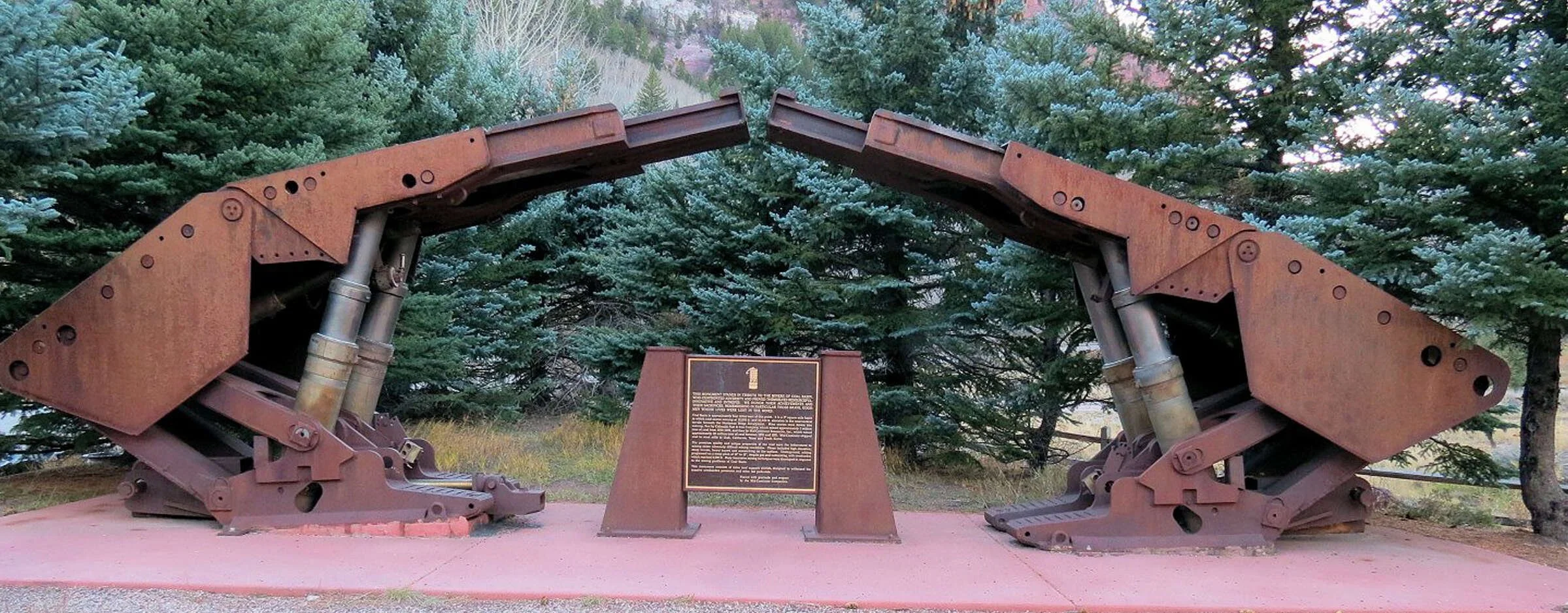
The Coal Basin Miners Memorial at the base of Coal Basin across Highway 133 from Redstone. Photo by Deb Strom.
Forty-five years later, our darkest days still echo from the peaks of Coal Basin up to Marble, down Redstone Boulevard, to the memorial in Sopris Park in Carbondale, and beyond. No longtime local does not remember that day, the collective pain, and the infinite capacity of neighbors and residents for being there for one another. It still brings tears to many eyes, still represents deep losses felt, of lives permanently changed, childhoods interrupted, young lives ended far too soon.
Where the darkness of those days can weigh on us even nearly half a century later, what also carries through the dust of time to the present is the shining example of our communities when faced with the most unimaginable tragedy. The capacity of all of us to exist in those moments with our hearts open and arms wide to embrace those carrying the most pain.
The story of the Dutch Creek Mine disaster is not one shared with you in these pages to dwell on tragedy, but rather one to celebrate the endearing spirit of community that has been a hallmark of our towns for decades. To celebrate the teachers, who knew the worst depths of the darkness, who took on the role of caregiver for their students, the children of the lost miners, who knew that in that dark moment, all they could do was make sure those kids knew that they still had a community that would take care of them. It is to celebrate the neighbors, coworkers and friends who quietly came over to check on families grieving, who, without being asked, picked up the tools of fathers gone too soon and finished backyard basketball courts in a solemn dedication to their fallen friends. It is to celebrate the neighbors who cooked meals, who offered hugs, and who truly stood by the promise to do whatever they could for whoever needed it. It is to celebrate the men and women of our towns who became parents to kids who needed an extra one, who would endeavor over the years to make sure that they always had someone there.
Ultimately what we may reflect on in our collective loss is that despite the pain that still lingers, despite the tears that still flow, and the memories that still haunt us, we can also reflect in pride for who we are as a community, for that unshakable sprit of camaraderie, of the small town spirit that saw cowboys, coal miners, and hippies stand together shoulder to shoulder and express compassion through grief, care despite pain, and community in spite of loss. This month we may reflect equally on the souls lost below ground, and the countless moments of shared compassion that defined our communities during these harrowing hours on the surface.
As our communities shared these moments of compassion and tragedy together, their voices came together and were preserved in the Valley Journal for the families in the moment, and for us in the present.
Mrs. Verona Hill, a retired teacher from Carbondale Elementary and Roaring Fork High School, penned a letter titled "A Teacher’s Sorrow” in the April 23rd edition of the Valley Journal. She begins it addressed “To the families of Tom, Glen and Ronnie, Their Friends.”
“Tears have been shed,” she writes of the crushing tragedy. “One does not teach in a small community without knowing students intimately,” she wrote. “They come to you with their confidences, their problems. You willingly share their joys of accomplishment, and their hopes and dreams are all in that pattern”. She captured the sense of interconnectivity we still share in our communities, despite their growth in size. How we watch one another grow up here, how life takes its twists and turns from our days on the playgrounds out into the broader strokes of the larger world. This valley, these towns, these communities carry those of us that grew up here, and those of us that live here wherever we go. What has not changed from those days is that network of care. The idea that it truly does take a village to raise a child.
When these villages embody that spirit shown by Roaring Fork and Crystal Valley residents that horrible week in April, 1981, it proves to each of us here, and those far beyond the valley walls that what stands above all else in a world of uncertainty, tragedy and darkness is the depth of the human capacity for empathy, for taking care of one another, and ultimately, for standing up as one together in the face of tragedy to ensure memories, stories, and compassion ring out in contrast to the absence of light in darkness.
Also included in the April 23rd issue of the Valley Journal were two poems in memory of the lost miners.
The first, titled “Where Mice Play” was reportedly found in the lamp house at Dutch Creek No. 1 the night of April 20th, 1981. Its author is unknown:
Where Mice Play
The night before,
Kelly and I talked,
Future plans, rock jams,
Midnight dreams, long coal seams;
The day before, Patch, Brett and I,
Talked children, bikes,
Exhaust fans, new vans;
Teaching Bill to drive Elkhorns,
Dan to ride belts,
Talked of young loves, football,
With backs to black walls;
Delivering supplies, joking
with Loren,
Rich saying “You’ll shovel belts yet,”
A dream home of Kyle’s
As we rode the trip, up the
cold mile;
How much coal John? Roof bolt
all night,
Hey Eugene, buggy’s down in 102,
Glen and I talking of kids,
Terry and Tom looking for Miner bids;
And Rags, we fed the mice, talking
of life,
You were taking me to Marble,
To walk the trails,
Getting high on sunny dales;
Everyone knew it was possible.
It couldn’t be me.
Now we ride the rubber
Highway, FREE.
Beverly Hendrickson, in a Letter to the Editor, shared the following verse as well:
April 15, 1981
Let there be a new tomorrow
where yesterday has been.
A margin of time to borrow,
a chance to lose or win.
May there be good friends
among you
still walking in the sun
Who will keep in trust
the memory
of “Dutch Creek Number One.”
Ultimately, while the tragedy of April 1981 is a deep scar that is still felt in our valleys, and while scars never fully heal, what we make collectively take solace in as we remember those fifteen miners this month is that when tragedy struck and when hope slowly faded into grief, we did not shy away from the responsibility we all have to one another. We remember the lost, and celebrate the living who did everything they could that spring for those feeling the loss the most.
This story was written using information collected by the Mining Safety and Health Administration and published in their official report of the accident, stories and reporting from The Valley Journal newspaper, information from the Redstone Historical Society, The New York Times, and accounts from locals who recall the events to this day. This issue of The Crystal Valley Echo is dedicated to the memory of the fifteen miners who lost their lives in the 1981 accident, their families and friends who lost fathers, brothers, and friends, the mine rescue teams from near and far who worked furiously to try to rescue the trapped men, and the countless community members who stood together to support one another in the face of true darkness.
